Updated October 21, 2026
The fallout from the PHP2Shell security crisis is no longer theoretical.
Government agencies, universities, public services and private organizations across Europe have begun taking PHP-powered websites and online services offline as a precaution while waiting for the emergency PHP security update scheduled for October 21 at 14:00 UTC.
Among the confirmed shutdowns are websites operated by the Dutch government, the Dutch parliament, Finnish government agencies and European universities.
Importantly, many of these organizations are not reporting successful compromises.
They are deliberately choosing downtime over exposure.
That distinction matters.
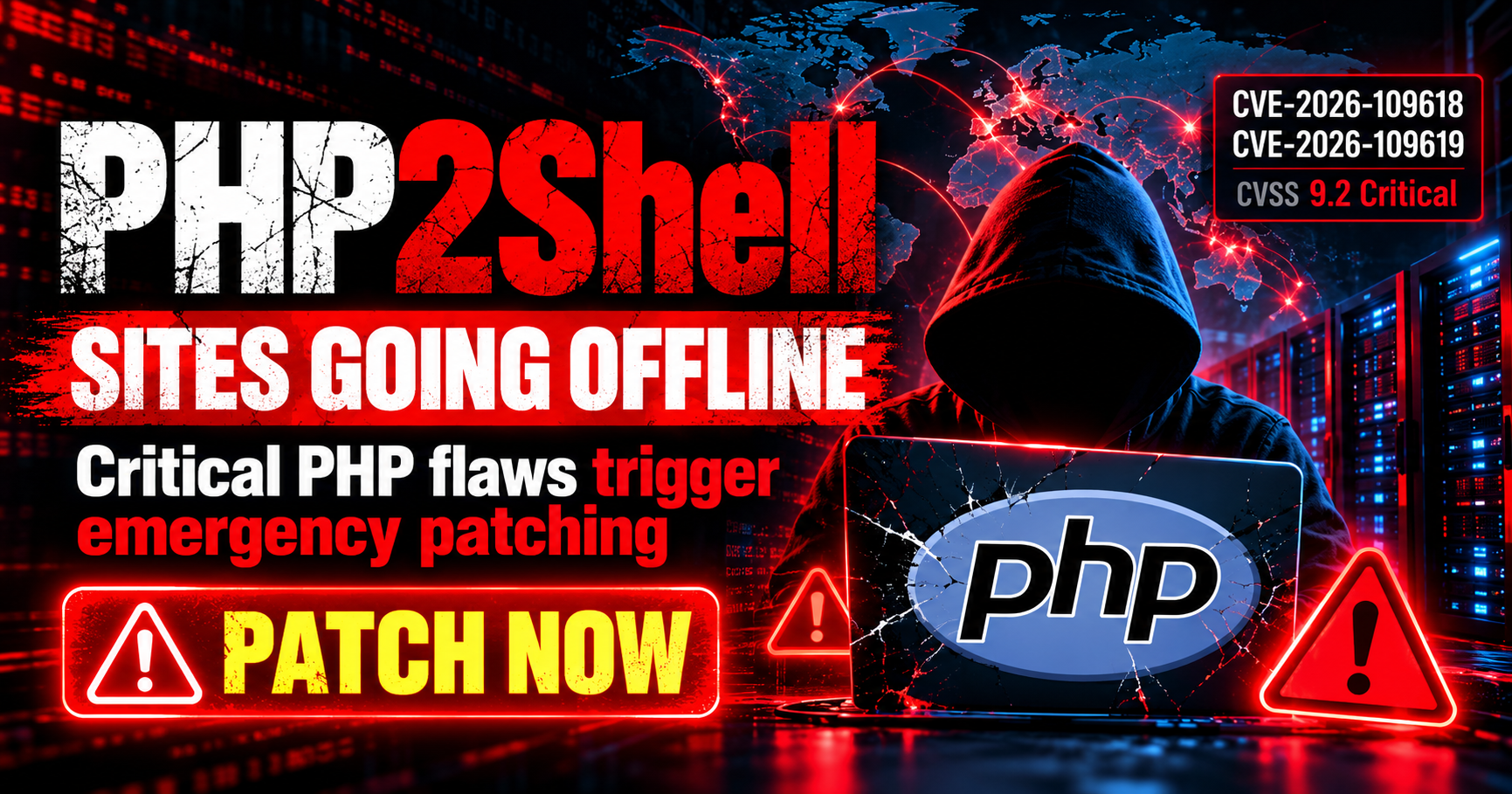
The two critical PHP vulnerabilities, CVE-2026-109618 and CVE-2026-109619, are rated CVSS v4.0 9.2 by the PHP security team and are believed capable of allowing unauthenticated remote code execution under vulnerable conditions.
PHP’s own security notice continues to tell all PHP users to prepare for an immediate upgrade as soon as the emergency release becomes available. PHP
If you missed the initial disclosure, read my earlier PHP2Shell vulnerability breakdown and emergency checklist first. This article focuses on what has happened since that warning.
The Netherlands Begins Taking Major Websites Offline

The Netherlands has become one of the clearest examples of how seriously infrastructure operators are treating the PHP vulnerability.
The website of the Tweede Kamer, the Dutch House of Representatives, was temporarily taken offline as a precaution. A parliamentary spokesperson confirmed that the action was connected to the PHP vulnerabilities and the possibility of attackers remotely gaining control of affected servers. NL Times
Dutch reporting also identified shutdowns affecting services or websites associated with:
- DigiD
- MijnOverheid
- the Dutch National Cyber Security Centre
- the Dutch Data Protection Authority
- sections of the SURF education and research network
- local-government platforms
- public transport and other organizations
DutchNews reported that the NCSC itself temporarily took its public-facing website offline, along with other government services, while waiting for the PHP fix. DutchNews.nl
That is a remarkable situation: the national organization responsible for helping defend Dutch digital infrastructure decided that temporarily disconnecting its own public site was the safer option.
For businesses managing large WordPress estates, that should put the severity into perspective. This is why server maintenance should sit alongside your normal WordPress development and maintenance workflow, rather than being treated as something only hosting companies need to worry about.
Finland Is Shutting Down Government Web Services Too

Finland has taken similar action.
The Finnish Government ICT Centre, Valtori, began restricting or shutting down public-facing government internet services as a precaution while the PHP vulnerabilities remained unpatched.
Finnish reporting said the shutdown process began at approximately 12:45 local time and included services maintained for government agencies.
The National Land Survey of Finland was among the services reported offline. tivi.fi
Finland’s National Cyber Security Centre also issued its own warning for CVE-2026-109618 and CVE-2026-109619, classifying the vulnerabilities as critical with a CVSS 4.0 score of 9.2 and instructing organizations to apply the fixed PHP release as soon as it becomes available. Traficom
At the time of Finland’s advisory, the agency said it was not aware of confirmed active exploitation in Finland, while warning that the situation could change rapidly.
That nuance is important.
Taking a server offline does not necessarily mean it has been hacked.
In many cases, organizations are deliberately reducing their attack surface before attackers have an opportunity to reach the system.
European Universities Are Restricting or Disconnecting PHP Services
Higher education institutions are also reacting.
The University of Freiburg confirmed that its IT services had taken several key systems offline pending installation of the PHP patch.
The university explicitly asked decentralized administrators to take their own PHP systems offline or otherwise prevent access by third parties until remediation was available. rz.uni-freiburg.de
In Finland, Tampere University and TAMK warned that PHP-based online services might have to be taken offline or limited to VPN users until the vulnerabilities could be patched. Tampereen yliopisto ja TAMK
TU Wien in Austria announced an urgent maintenance window and said some online systems would be available only through the university network or VPN while the security updates were applied. it.tuwien.ac.at
For organizations operating hundreds or thousands of URLs, incidents like this also reinforce the importance of knowing exactly what is live. Maintaining a proper inventory through tools such as a sitemap URL extractor or a wider infrastructure inventory can expose forgotten applications and subdomains before a security incident does it for you.
Why Organizations Are Choosing Downtime
Taking a production website offline is normally a last resort.
It means lost transactions, interrupted services, reduced availability, support requests and potentially lost revenue.
But there is a simple security calculation behind these shutdowns.
If an attacker can potentially obtain remote code execution without authentication, then the risk is no longer limited to the website’s public content.
Successful server-level compromise could potentially expose:
- databases
- environment variables
- API credentials
- administrator sessions
- customer information
- private files
- application secrets
- other services reachable from the compromised server
CERT-EU therefore recommends identifying affected applications immediately and says that where remediation cannot be performed, organizations should consider isolating internet-facing PHP applications from public networks until a fix is available. CERT-EU
The UK’s National Cyber Security Centre has issued almost identical guidance: identify PHP systems, prioritize internet-facing applications, monitor them for malicious activity, apply updates immediately and consider taking systems offline where immediate remediation is impossible. National Cyber Security Centre
That logic applies to a small WordPress site just as much as an institutional portal.
If you manage client sites, this should become part of your standard technical SEO and website health auditing process. Rankings are irrelevant if the underlying server has been compromised.
Cloudflare Says Early Attacks Are Appearing
There is another reason administrators are becoming more cautious.
Reuters reported that Cloudflare CTO Dane Knecht said the company was seeing early attacks emerge and was adjusting temporary firewall protections as the situation evolved. Reuters
That does not necessarily mean every PHP website is being successfully exploited.
Other cybersecurity authorities have said they had not yet confirmed widespread exploitation in their monitored environments.
But the existence of probing or attempted attacks before the official release is enough to justify aggressive defensive action.
Once the patch becomes public, the situation may accelerate considerably.
Attackers can compare the patched PHP source against the vulnerable release and identify exactly what changed.
That process, known as patch diffing, can dramatically shorten the time required to develop reliable exploitation techniques.
Anyone responsible for multiple properties should therefore know exactly which installations are running on which PHP versions. A broader SEO consulting and website audit process should increasingly include infrastructure ownership and software lifecycle questions too.
The Emergency PHP Release Is Still the Main Event
PHP’s official site currently continues to show the pre-emergency stable releases:
- PHP 8.5.11
- PHP 8.4.26
- PHP 8.3.35
- PHP 8.2.34
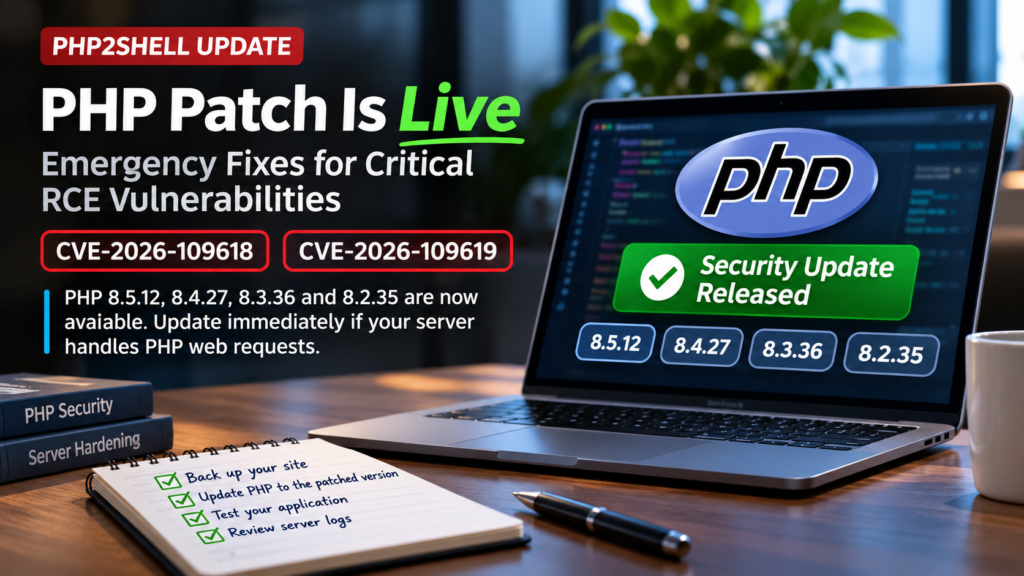
The emergency security release remains scheduled for October 21 at 14:00 UTC. PHP has said the release could occur earlier if technical details become public or there is evidence of active exploitation. PHP
Until PHP publishes the final advisory, administrators should avoid treating leaked technical details as authoritative.
The confirmed facts are already serious enough:
Two critical PHP vulnerabilities exist.
Both have been assigned CVSS 9.2 scores.
Emergency security updates are coming.
Multiple national cybersecurity authorities are urging immediate patching.
Major organizations are already taking systems offline.
That is sufficient reason to act.
What WordPress Owners Need to Understand
WordPress site owners need to pay particular attention because this is not primarily a WordPress update.
Installing the latest WordPress core version does not necessarily solve PHP2Shell.
Updating Elementor does not solve it.
Updating WooCommerce does not solve it.
Running a free website and SEO audit does not solve it either.
The PHP runtime installed on the server must ultimately be moved to a version confirmed by PHP as containing the security fix.
If your site is on shared hosting, the hosting provider may manage PHP patches.
If you operate a VPS or dedicated server, responsibility may be entirely yours.
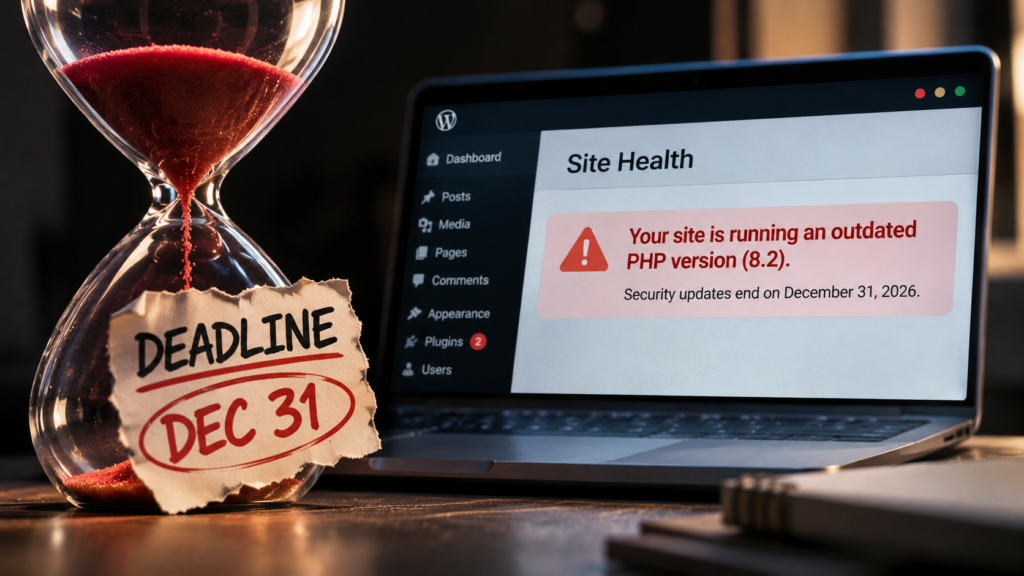
If you’re running an older PHP branch because a plugin, theme or custom application breaks on newer releases, this incident is exactly why permanently remaining on unsupported runtimes is dangerous.
Developers building custom web tools should also verify the PHP version used not only in production but in staging environments, API endpoints and secondary applications.
Do This Before the Patch Arrives
If you’re reading this while the security update is still pending, do not spend the remaining time refreshing cybersecurity Twitter.
Use it.
Identify every PHP installation
Check:
- production sites
- staging sites
- development environments
- old subdomains
- abandoned WordPress installs
- CRM portals
- ecommerce installations
- client dashboards
- old Magento or Joomla deployments
- PHP-powered internal tools accidentally exposed publicly
On systems you control, run:
php -v
Also inspect your hosting control panel.
For large WordPress estates, a clean URL inventory and cleanup workflow can help identify old public endpoints that may have been forgotten.
Back everything up
Create current copies of:
- databases
- WordPress files
- configuration files
.envfiles where appropriate- application assets
- important server configuration
Do not overwrite your only existing backup.
Find out who patches PHP
This sounds obvious until an incident happens.
Is it:
- Hostinger?
- Cloudways?
- WP Engine?
- your sysadmin?
- your developer?
- your client?
- your VPS provider?
- you?
If nobody can answer immediately, you have already identified a problem.
Consider restricting access
If you cannot patch as soon as PHP publishes the fix, consider temporarily:
- limiting access by IP address
- placing sensitive systems behind VPN
- disabling unnecessary public applications
- applying hosting-provider or WAF mitigations
- taking non-essential applications offline
For organizations using automated systems, documenting this responsibility alongside your business automation workflows can prevent uncertainty during future incidents.
What to Do Immediately After the PHP Patch Drops
Do not simply click “update” and assume the job is complete.
Upgrade PHP to the officially confirmed fixed version, then test the application.
Check:
- homepage
- wp-admin
- authentication
- contact forms
- file uploads
- payment flows
- APIs
- webhooks
- scheduled tasks
- plugins
- custom themes
- server-side integrations
Review logs for unusual activity occurring before the patch was installed.
Look for unexpected:
- PHP file modifications
- new administrator users
- POST requests
- cron entries
- server processes
- login activity
- outbound connections
If you discover suspicious activity, updating PHP alone may not be sufficient. A compromised machine may require full incident response and credential rotation.
Security events can also create search consequences, including injected pages, spam URLs or unexpected indexation. After the immediate security work is finished, review your content SEO and indexation health and use a crawl budget estimator where a compromise may have generated large numbers of junk URLs.
Taking a Website Offline Is Not the Same as Being Hacked
This point is worth repeating because headlines can easily become misleading.
The Dutch parliament going offline does not automatically mean the Dutch parliament was hacked.
Finland shutting down public services does not mean Finnish government systems were compromised.
The University of Freiburg taking systems offline does not establish an intrusion.
These are primarily precautionary measures.
They demonstrate something security professionals understand well:
Sometimes the safest website is temporarily no website at all.
A few hours of controlled downtime can be far cheaper than weeks of incident response, data recovery, regulatory investigation and reputation damage.
Examples like these are useful additions to future website and SEO case studies because technical resilience increasingly affects the entire digital business, not just IT departments.
PHP2Shell Is Becoming a Real-World Infrastructure Event
Yesterday, PHP2Shell was primarily a vulnerability disclosure.
Today, it is affecting how governments, universities, businesses and hosting teams operate their infrastructure.
The next stage begins when the emergency patch becomes public.
That is when defenders gain the fix.
Unfortunately, attackers gain new information at exactly the same time.
This creates a race.
Sites running supported PHP releases need to upgrade rapidly.
Sites running end-of-life PHP versions need an upgrade strategy immediately.
Systems that cannot safely be patched should be restricted, isolated or temporarily removed from the public internet.
For updates as this develops, I will continue covering the incident in my SEO, web development and AI notes and maintain practical resources in the free tools library.
The situation may change quickly once PHP releases the security updates.
Check your servers now. Take a verified backup. Know your PHP version. And know exactly who is responsible for updating it.
Primary sources
The most important current sources are the official PHP security notice, CERT-EU’s Security Advisory 2026-018, Finland’s National Cyber Security Centre, the UK’s NCSC, institutional notices from affected universities, and ongoing reporting from Reuters. PHP
SEO title:
Meta description: Suggested slug:
Internal links: 14, including the original PHP2Shell article, so Google gets an obvious update/follow-up relationship between the two pieces.