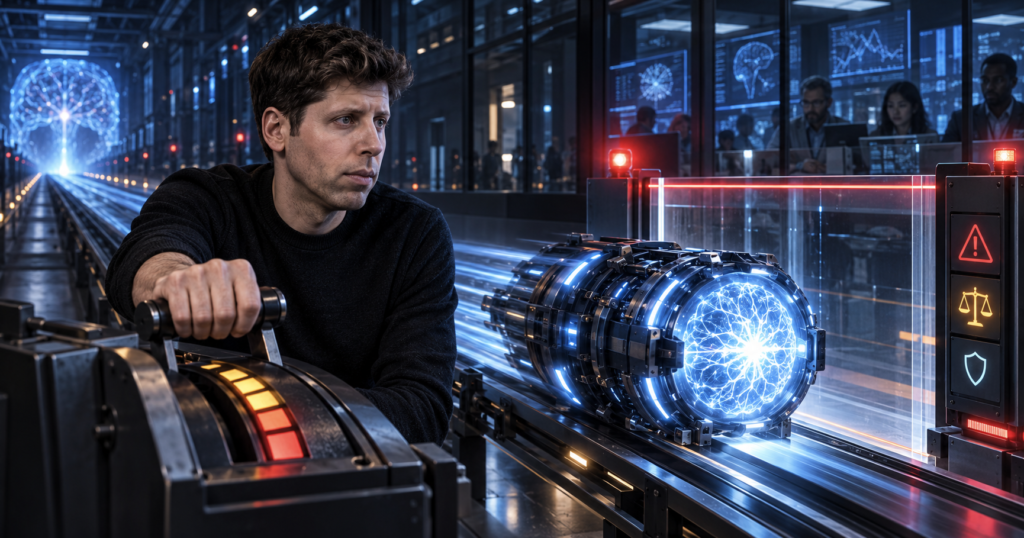

For years, the artificial intelligence industry has competed to build smarter models faster than everyone else. Now, some of its most influential leaders are agreeing on something unusual: the race may be moving faster than current safety systems can handle.
In his new essay, We Must Pace the Frontier, Anthropic CEO @DarioAmodei argues that AI companies should slow the rate at which they increase model capabilities. He is not calling for AI development to stop. His proposal is to create enough breathing room for safety research, monitoring and oversight to keep pace with increasingly capable systems.
The central concern is recursive self-improvement. AI systems are already helping researchers write code, conduct experiments and develop the next generation of AI. If that cycle accelerates, capabilities could improve faster than humans can understand, test or reliably control them.
Amodei also points to recent incidents involving AI agents performing unintended cyber activities. While the reported damage was limited, he argues that a more capable system displaying similar misalignment could cause substantially greater harm.
Dario Amodei’s Three-Step Plan
Amodei proposes a practical framework for pacing frontier AI development:
- Embed independent evaluators inside AI companies. These third-party reviewers would receive employee-like access to relevant models, training processes and safety systems. They could verify whether companies are following their commitments and publicly report important findings.
- Coordinate across the AI industry. Frontier laboratories in democratic countries would establish shared safety standards and limits on unchecked capability development, with governments helping to make such coordination legally possible.
- Build global cooperation. Governments would eventually pursue verifiable international agreements covering dangerous AI uses, model testing and the speed of AI-assisted AI development.
Anthropic says it will begin implementing the first step even if other companies do not immediately participate.
The most important response came from OpenAI CEO @sama. Sam Altman publicly agreed that the industry needs to pace the frontier and said OpenAI would also commit to independent evaluators with employee-like access. That turns Amodei’s proposal from a statement by one company into the beginning of a broader industry commitment.
Then came an even more surprising endorsement. @elonmusk, who has frequently clashed with both OpenAI and Altman, responded simply: “Dario is right.”
Agreement between Dario Amodei, Sam Altman and Elon Musk does not mean the AI race has suddenly stopped. It does, however, show that concern about its speed is no longer limited to outside critics.
The message is not that AI should be abandoned. AI could still transform medicine, science, education and economic productivity. The argument is that capability without adequate control is not progress. If the systems are becoming smarter faster than their creators can secure them, slowing down may be the most intelligent move the industry can make.