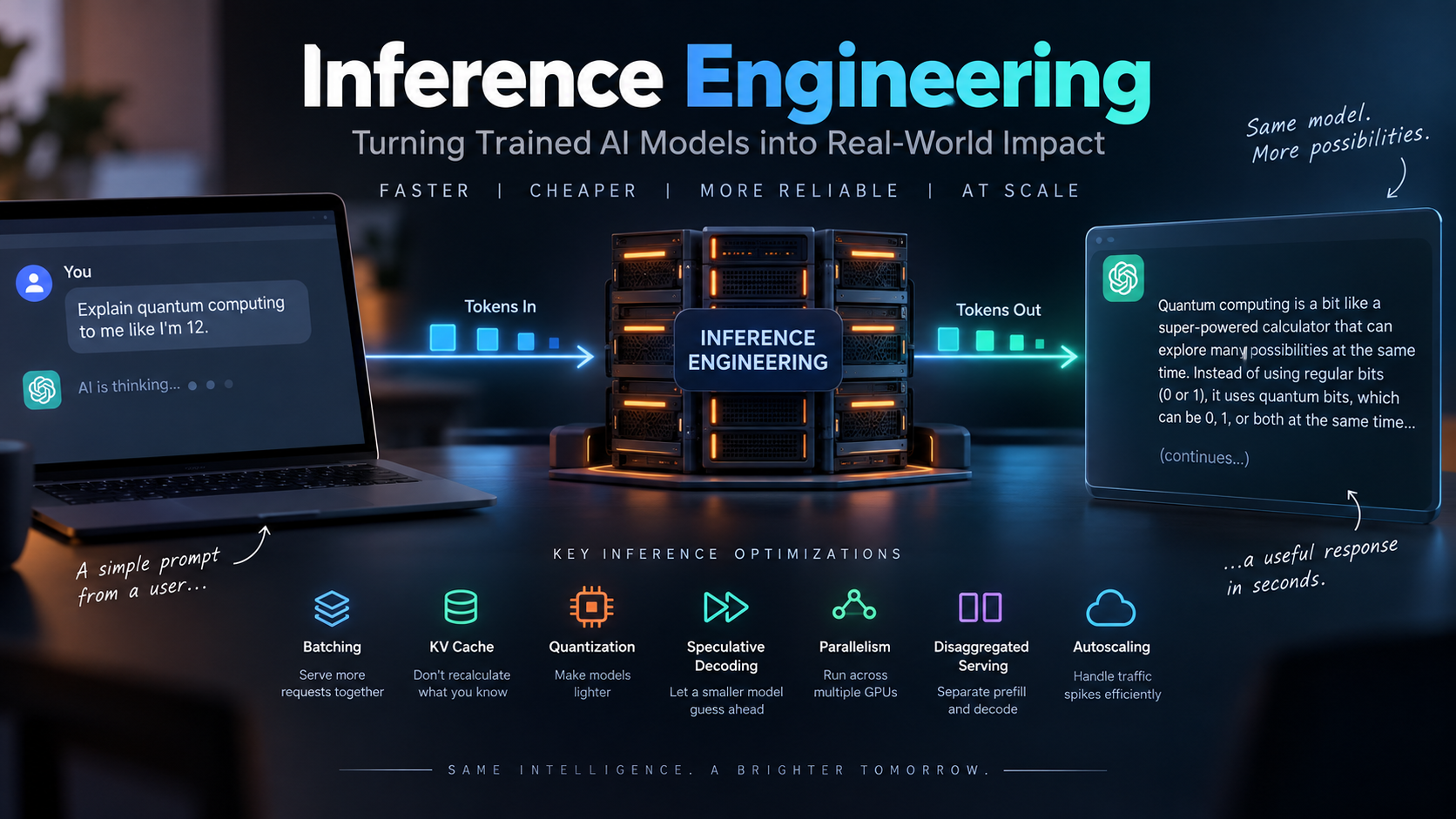
You type a question into ChatGPT.
For a moment, nothing happens. Then the answer starts appearing word by word.
Behind those few seconds is an enormous amount of engineering.
A large language model has to process your prompt, understand the context, perform billions of mathematical operations, generate the next token, and repeat the process until the response is complete. And if millions of people are doing the same thing at once, the system somehow has to keep doing it without becoming painfully slow or absurdly expensive.
Making all of that work is where inference engineering comes in.
It is becoming one of the most important disciplines in modern AI infrastructure, especially as companies move beyond experimenting with AI and start building products that depend on models every minute of the day.
But what exactly is inference engineering, and why are we hearing so much about it now?
Let’s start with inference itself.
What Is AI Inference?
An AI model generally goes through two major stages: training and inference.
Training is when the model learns.
Huge amounts of data are processed using powerful computing infrastructure to determine the model’s internal parameters, commonly called weights.
Training a frontier model can require enormous clusters of GPUs and take weeks or months.
But once the model has been trained, something different happens.
People start using it.
When you ask an AI model to write an email, summarize a document, generate an image, explain some code, or answer a question, the model isn’t normally being trained again.
It is running inference.
In simple terms:
Training creates the model. Inference uses the model.
For traditional machine-learning systems, inference could be relatively straightforward. A model might receive a few values and return a prediction.
Generative AI changed the equation.
Large language models can contain billions of parameters. They process long prompts and generate outputs token by token while potentially handling thousands or millions of simultaneous users.
Suddenly, “just running the model” became a serious engineering problem.
So, What Is Inference Engineering?
Inference engineering is the discipline of making trained AI models run efficiently in real-world applications.
An inference engineer isn’t necessarily trying to make the model smarter.
Instead, they’re asking questions such as:
Can we make it respond faster?
Can we serve more users using the same hardware?
Can we reduce GPU costs?
Can we handle sudden traffic spikes?
Can we run this model across several GPUs?
Can we reduce memory consumption without hurting the quality of the answers?
Can we keep the service available if a GPU, server, region, or cloud provider fails?
This makes inference engineering a combination of AI, software engineering, systems engineering, performance optimization, and infrastructure engineering.
A useful analogy is the difference between designing a Formula 1 engine and operating a transportation network.
Training produces an incredibly powerful engine.
Inference engineering figures out how to use that engine efficiently when thousands or millions of people need transportation.
What Happens When You Send an AI Prompt?
Consider a simple prompt:
“Explain quantum computing to me like I’m 12.”
You press Enter.
From your perspective, the AI thinks for a moment and begins typing.
From the system’s perspective, considerably more is happening.
Your text is first converted into smaller units called tokens. Tokens might represent entire words, pieces of words, punctuation, or other text elements.
Those tokens are passed through the neural network.
The model calculates probabilities for what token should come next.
It chooses one.
Then it repeats the process.
Again.
And again.
And again.
This is why AI responses often appear progressively instead of arriving as one giant block of text.
Every generated token requires computation.
Multiply that by a long response, then multiply it again by thousands of concurrent users, and you begin to see the infrastructure challenge.
Prefill and Decode: The Two Important Phases
LLM inference can broadly be divided into two phases: prefill and decode.
During prefill, the model processes the prompt you’ve provided.
If you paste a 20-page document into an AI application, the model needs to process that context before it can meaningfully respond.
Then comes decode.
During decoding, the model generates the response, usually one token at a time.
These two phases behave differently from a computing perspective.
Prefill can involve substantial computation because many input tokens need to be processed. Decode repeatedly accesses model data while generating new tokens.
That distinction matters because optimizing one phase doesn’t automatically optimize the other.
It is one of the reasons inference engineering becomes much more complicated than simply saying, “Let’s buy a faster GPU.”
The Three Numbers That Affect How Fast AI Feels
You don’t need to be an inference engineer to understand three useful measurements.
The first is Time to First Token (TTFT).
This is roughly how long you wait before the AI begins responding.
If you submit a prompt and stare at an empty screen for five seconds, TTFT is probably what you’re noticing.
The second is Tokens Per Second (TPS).
Once the response starts, TPS measures how quickly tokens are generated.
Think of it as the AI’s typing speed.
The third is Inter-Token Latency (ITL), which measures the delay between one generated token and the next.
Together, these metrics heavily influence whether an AI application feels instant and fluid or slow and frustrating.
And milliseconds start mattering when AI becomes part of applications such as coding assistants, search engines and voice agents.
Why Not Just Use More GPUs?
At first glance, inference seems to have an obvious solution.
If AI is slow, add more GPUs.
Unfortunately, GPUs are expensive, and throwing hardware at the problem doesn’t guarantee efficient performance.
Imagine running a restaurant where every customer gets their own chef, kitchen, oven and refrigerator.
Service might be excellent.
The economics would be terrible.
AI infrastructure faces a similar problem.
A well-designed inference system tries to squeeze considerably more useful work from the hardware already available.
That’s where techniques such as batching, caching, quantization, speculative decoding and parallelism become important.
Batching: Serving Multiple Requests Together
Suppose 50 users send prompts around the same time.
A naive system could process every request separately.
A more efficient system can batch requests together so the GPU works on multiple requests simultaneously.
This improves hardware utilization and increases throughput.
But there’s a catch.
Bigger batches can improve efficiency while potentially increasing latency.
If you wait too long to assemble a batch, individual users might wait longer for their responses.
Inference engineering therefore involves balancing two competing goals:
Serve each user quickly while serving many users efficiently.
There isn’t one perfect batch size for every application.
KV Cache: Don’t Recalculate What You Already Know
Another important optimization is the KV cache, short for key-value cache.
LLMs rely heavily on an attention mechanism to understand relationships between tokens.
Without caching, the model would repeatedly perform calculations for tokens it has already processed while generating a response.
The KV cache stores useful results from previous calculations so they can be reused.
Think of solving a long maths problem and writing your intermediate answers on paper.
If you erase the page after every step, you’ll repeatedly redo the same work.
Keeping those intermediate results saves time.
That’s essentially the benefit caching provides during inference.
The challenge is that KV caches consume memory, and memory is one of the most valuable resources on a GPU.
So once again, optimization becomes a balancing act.
Quantization: Making Models Lighter
Large AI models normally store enormous numbers of numerical values.
Those values can be represented at different levels of precision.
Quantization reduces the precision used to represent some of those values.
Instead of storing everything at higher precision, engineers might use lower-precision formats where appropriate.
Why?
Because lower precision can reduce memory requirements and allow hardware to perform operations more efficiently.
Imagine recording every price as:
₹99.000000000
when:
₹99
would be sufficient.
You’re storing more information than you actually need.
Quantization applies a much more sophisticated version of that idea to neural networks.
The challenge is obvious: reduce precision too aggressively and model quality can deteriorate.
The goal isn’t simply to make the model smaller.
It’s to make it smaller without users noticing a meaningful loss in quality.
Speculative Decoding: Let a Smaller Model Guess Ahead
One of the more interesting inference techniques is speculative decoding.
Normally, an LLM generates tokens sequentially.
One token.
Then another.
Then another.
Speculative decoding introduces something like an assistant.
A smaller or faster model predicts several tokens ahead. The larger model then checks those predictions.
If they’re correct, multiple tokens can effectively be accepted together.
Imagine a senior editor working with a junior writer.
Instead of the editor typing every sentence from scratch, the junior writer drafts several sentences. The senior editor quickly verifies them.
If they’re good, they stay.
If they’re wrong, they’re replaced.
The important part is that the final model still verifies the output.
When implemented effectively, this can increase generation speed.
Parallelism: One Model, Multiple GPUs
Some models are simply too large, or too demanding, to run efficiently on one GPU.
So engineers divide the workload.
This broadly falls under parallelism.
Different strategies divide different parts of the model or computation across multiple GPUs.
For example, tensor parallelism splits mathematical operations across GPUs so they can work together.
Mixture-of-Experts models introduce another interesting challenge because only certain “experts” inside the network may be activated for a given token.
The objective remains the same:
Use multiple pieces of hardware without communication between them becoming a new bottleneck.
Adding ten GPUs doesn’t automatically make inference ten times faster.
Coordinating those GPUs efficiently is part of the engineering problem.
Disaggregating Prefill and Decode
Remember the two phases we discussed earlier?
Prefill processes the prompt.
Decode generates the answer.
Because they have different computational characteristics, some inference architectures separate them onto different workers or hardware resources.
This is called disaggregation.
Instead of forcing the same GPU resources to handle both workloads in exactly the same way, infrastructure can be specialized and scaled independently.
It is similar to a restaurant separating food preparation from final cooking.
Both are necessary, but they have different resource requirements.
Separating them can make the overall operation more efficient.
Inference Engineering Is Also an Infrastructure Problem
Making one model run quickly on one GPU is only part of the job.
What happens when 10 users become 10,000?
Now you need infrastructure.
AI traffic is rarely perfectly predictable. Usage can spike because of product launches, business hours, viral features, batch jobs or major events.
Running enough GPUs for peak demand all day would waste enormous amounts of money.
Running too few means users wait.
That’s why production inference systems use autoscaling.
Infrastructure adds GPU capacity as demand increases and reduces it when traffic falls.
At larger scales, things become even more complicated.
Companies might run GPUs across multiple data centers, regions or cloud providers.
Now inference engineering starts overlapping with distributed systems engineering.
Engineers have to think about networking, GPU availability, load balancing, failures, latency, capacity planning and geographic distribution.
The AI model may be the star of the show, but an enormous amount of conventional systems engineering keeps that star on stage.
Why Inference Cost Matters So Much
Training an AI model is expensive.
But training is primarily an upfront cost.
Inference keeps happening for as long as people use the product.
One user asks 10 questions.
Another generates 500 lines of code.
A company summarizes 100,000 documents.
An AI agent might make dozens of model calls while completing a single task.
Every request consumes compute.
That means a seemingly tiny efficiency improvement can become financially significant at scale.
If an optimization reduces the computing cost of a high-volume AI workload by even 10%, the savings can become substantial.
Inference engineering therefore isn’t only a performance discipline.
It’s an economics discipline.
Engineers constantly balance speed, model quality, reliability and cost.
Why Inference Engineering Is Becoming More Important
For the first few years of the generative AI boom, many developers interacted with models almost entirely through APIs.
Send a request.
Receive a response.
Pay for the tokens.
That model isn’t disappearing.
But the AI ecosystem is becoming much broader.
Open-weight models are increasingly capable, companies are deploying customized models, AI agents are making far more model calls, and AI features are moving from experiments into production software.
Once organizations operate models themselves, they gain more control.
But they also inherit the optimization problem.
Suddenly questions such as these matter:
Which GPU should we use?
How many requests can one instance handle?
Should the model be quantized?
How should requests be batched?
What should we cache?
When should infrastructure scale?
How do we reduce latency?
How do we survive hardware failures?
At that point, inference engineering stops being an academic concept.
It becomes part of running the business.
Do All AI Companies Need Inference Engineers?
Not necessarily.
A small startup making a few thousand model calls per month probably shouldn’t build an elaborate inference platform.
Using an existing API may be cheaper, faster and dramatically simpler.
Inference engineering becomes increasingly valuable as usage grows or when a product has unusual requirements around latency, privacy, reliability, customization or cost.
The decision should therefore be driven by economics and product requirements rather than technical excitement.
Sometimes the best inference architecture is somebody else’s API.
Sometimes owning the infrastructure becomes a competitive advantage.
Knowing when that transition happens is itself an engineering decision.
Is Inference Engineering the Next Big AI Career?
There is certainly a strong reason engineers are paying attention to it.
AI models receive most of the headlines, but models don’t magically become reliable products.
Someone has to deploy them.
Someone has to optimize them.
Someone has to make them affordable.
Someone has to make them respond quickly when millions of requests arrive.
And someone has to keep the whole system running when hardware inevitably fails.
Inference engineering sits directly in the middle of those problems.
It combines knowledge from machine learning, GPU computing, distributed systems, networking, cloud infrastructure and performance engineering.
You don’t need to master all of those areas overnight.
But engineers who understand how AI models behave after training are likely to become increasingly valuable as AI infrastructure matures.
The Future of AI Isn’t Just About Bigger Models
For years, much of the AI conversation revolved around training.
More parameters.
More GPUs.
More data.
Larger models.
But intelligence alone doesn’t create a useful product.
A model also needs to be available, responsive and economically viable.
Users don’t care how impressive your benchmark score is if your AI assistant takes 30 seconds to answer.
Businesses don’t care how clever the model is if every customer interaction loses money.
That’s why inference engineering matters.
The next generation of AI improvements won’t come only from making models smarter.
Some will come from making existing models faster, cheaper and easier to serve at enormous scale.
Training creates intelligence.
Inference puts that intelligence to work.
And inference engineering is what makes putting it to work practical.