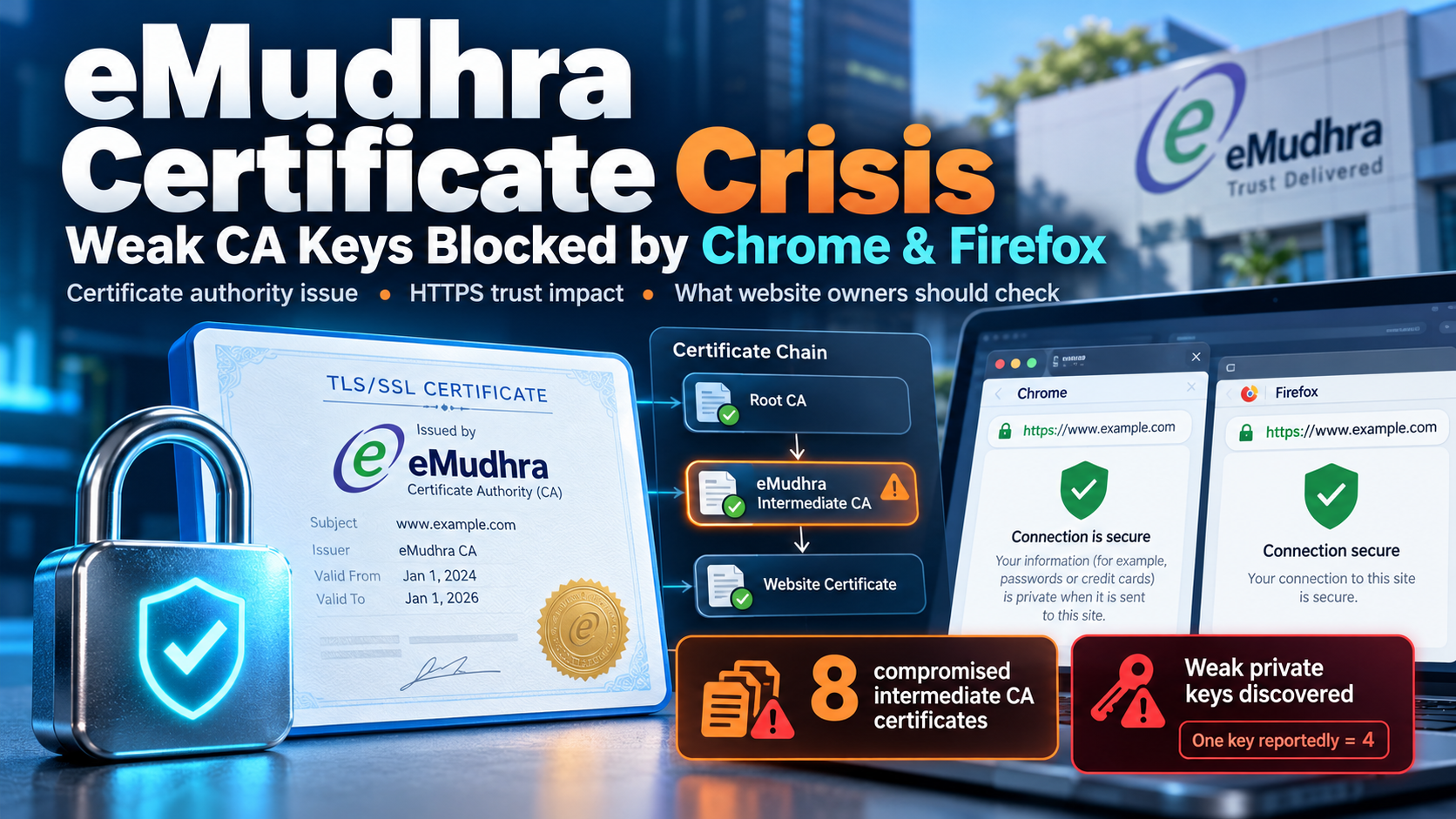
A serious certificate-authority security incident involving Indian digital trust company eMudhra has forced Google, Mozilla and other major platform operators to revoke trust in multiple eMudhra certificate-authority certificates.
The problem is extraordinary because of how weak some of the cryptographic keys reportedly were.


Security researchers examining the affected certificates found private keys represented by tiny numbers. One was reportedly simply 4. Others included numbers such as 56 and 115.
For context, these keys were supposed to be generated from an astronomically large cryptographic key space where guessing the correct private key should be practically impossible.
Instead, researchers were able to independently recover the affected keys.
Google has confirmed that private keys associated with eight eMudhra subordinate Certificate Authority certificates were generated with insufficient cryptographic randomness, making it possible to forge trusted HTTPS certificates for websites an attacker does not own. blog.google
Mozilla independently confirmed the compromise and blocked the affected intermediate certificates in Firefox. Mozilla Blog
eMudhra has now acknowledged the incident and says the problem originated during an April 2025 key-generation ceremony. The company says its underlying infrastructure was not compromised, no customer data breach has been identified, and its Indian DSC and eSign businesses are unaffected. eMudhra
So what happened?
And, more importantly, what should website owners do?
First: This Is Not the Same Incident as PHP2Shell
The timing is almost comically bad for website administrators.
The eMudhra certificate incident emerged just as administrators were already preparing for the critical PHP2Shell vulnerabilities affecting PHP servers.
But these are completely separate security events.
PHP2Shell concerns vulnerabilities in PHP that potentially allow attackers to execute code on vulnerable servers.
The eMudhra incident concerns the infrastructure used to establish cryptographic trust between websites and users.
If you are also dealing with the PHP issue, see my earlier PHP2Shell coverage and keep your server-side patching work separate from your TLS certificate review.
The bigger lesson is the same, though: security cannot be reduced to simply keeping WordPress plugins updated.
A comprehensive technical SEO and website health strategy increasingly needs to include the infrastructure supporting the website itself.
What Does a Certificate Authority Actually Do?
When you visit a website beginning with HTTPS, your browser needs a way to determine whether it is really communicating with that website.
The site’s TLS certificate establishes its identity and enables encrypted communication.
But your browser cannot personally investigate every website on the internet.
Instead, it trusts certain organizations known as Certificate Authorities, or CAs.
These organizations digitally sign certificates.
Your browser effectively says:
I trust this Certificate Authority, therefore I will trust certificates legitimately issued through its approved hierarchy.
eMudhra operates such certificate-authority infrastructure.
That is why this incident matters far beyond eMudhra’s own website.
If an attacker possesses the private key of a trusted intermediate Certificate Authority, the attacker could potentially create a certificate claiming to belong to a website they do not control.
Google explained the consequence directly: the compromised keys could allow forged HTTPS certificates to impersonate arbitrary websites against clients that continued trusting those certificate authorities. blog.google
What Exactly Went Wrong at eMudhra?
eMudhra has now provided its own explanation.
The affected certificates were generated during a Key Generation Ceremony on April 30, 2025.
According to eMudhra, the process used FIPS 140-2 Level 3 Hardware Security Modules.
However, a flaw occurred during a cryptographic wrap/unwrap operation.
Instead of producing only the intended strong cryptographic keys, the process generated a second set of weak keys.
Those weak keys were subsequently published into the browser trust ecosystem. eMudhra
The company says it is still determining the precise root cause.
That means this does not currently appear to be a case where hackers broke into eMudhra’s infrastructure and stole cryptographic keys.
The problem appears to have occurred during key creation itself.
That distinction matters.
One Private Key Was Reportedly Literally the Number 4
This is the detail that has understandably captured everyone’s attention.
Independent security researchers examining the affected cryptographic material reportedly recovered extremely small private-key values.
One was:
4
Not a massive hexadecimal value beginning with 4.
Not a huge randomly generated number.
Just four.
Other reported values included 56, 66, 115, 155, 156, 230 and 237.
Researchers said these values could be derived from the public certificates extremely quickly because there were so few possible candidates. The Register
Proper elliptic-curve cryptographic private keys should be selected randomly from a vast mathematical space.
The entire security model depends on an attacker being unable to reverse-engineer the private key from the public key within any practical amount of time.
Here, that assumption collapsed.
Mozilla’s public incident record says Mozilla engineers were independently able to recover the affected private keys, confirming that the generation process was flawed and easy to exploit. Bugzilla
That is about as definitive as cryptographic failures get.
Google Reacted Within Hours
The initial report reached Google’s Chrome Root Program on October 17, 2026 at 18:05 UTC.
Google says it had corroborated the findings by 19:45 UTC.
Chrome then pushed a CRLSet update that blocked the Subject Public Key Info hashes associated with the affected intermediates.
Because that protection is distributed independently of normal browser updates, Chrome users did not need to manually update or restart their browsers to receive the initial protection. blog.google
Google also distributed equivalent protection to Android devices through Google Play Services.
This is an important reason ordinary users should not panic.
The major browser vendors moved quickly.
For website operators, however, there is considerably more work to do.
Mozilla Blocked the Certificates Too
Mozilla was notified about the compromise on October 17.
Firefox engineers responded by adding the affected intermediate certificates to OneCRL, Mozilla’s centralized certificate revocation mechanism.
Mozilla says the protection had reached standard Firefox configurations by 22:59 UTC, less than three hours after receiving the report. Mozilla Blog
Mozilla has additionally released:
- Firefox 158.0.1
- Firefox ESR 115.43.1
- Firefox ESR 153.5.1
Those updates ensure protection for users whose unusual configurations could have prevented normal OneCRL distribution.
Mozilla is also updating NSS to remove the relevant root certificate for applications using Mozilla’s trust store but not its normal browser revocation mechanism. Mozilla Blog
If you’re maintaining a significant number of WordPress properties, incidents like this are another reason your WordPress development process should include hosting, certificates, PHP versions and DNS, rather than focusing exclusively on WordPress itself.
Chrome Is Removing an eMudhra Root Certificate
Google’s response goes further than simply blocking the compromised intermediate certificates.
The company has removed emSign ECC Root CA – G3 from the Chrome Root Store.
Google says the change is expected to reach devices relying on the Chrome Root Store beginning on October 27, 2026, with prerelease Chrome channels receiving the change sooner. blog.google
This is where website owners need to pay attention.
Google specifically warns that some legitimate certificates chaining to that root will stop functioning in Chrome.
Website operators whose TLS certificate chains through:
emSign ECC Root CA – G3
should obtain and install a replacement certificate through another trusted PKI hierarchy before the Chrome distrust rollout reaches their users. blog.google
Do not wait until customers start reporting HTTPS errors.
How Do I Know Whether My Website Is Affected?
If you manage a website, inspect its certificate chain.
The easiest method is through your browser.
Click the padlock/security controls beside the URL, inspect the certificate information and examine the certificate chain.
Administrators can also use OpenSSL:
openssl s_client -connect example.com:443 -servername example.com -showcerts
Replace example.com with your domain.
You are looking particularly for chains involving the eMudhra root that Google has announced it will remove.
If you manage dozens or hundreds of sites, document the results.
The same inventory discipline applies when carrying out a full website audit. You cannot protect infrastructure that nobody remembers exists.
Does This Mean eMudhra Was Hacked?
Based on currently available evidence, no.
That needs to be stated clearly.
eMudhra says:
- its infrastructure was not compromised;
- no data breach occurred;
- physical and logical security controls remained intact;
- India’s DSC and eSign businesses are unaffected.
The company says those Indian services operate separately from the affected Global TLS infrastructure. eMudhra
So describing this simply as an “eMudhra hack” would be inaccurate.
The problem is arguably stranger.
Cryptographic material that was supposed to be virtually impossible to derive appears to have been generated incorrectly in the first place.
Were Customer Certificates Actually Issued Using the Compromised CAs?
There is some reassuring news here.
Google says it found no TLS certificates chaining through the six affected TLS intermediate CAs in Certificate Transparency logs before Chrome blocked them.
That means fraudulent certificates through those intermediates could not have successfully been used against Chrome and other clients that strictly enforce Certificate Transparency requirements. blog.google
eMudhra has also said the affected intermediate CAs had not issued end-entity certificates. eMudhra
That substantially reduces the evidence for actual abuse.
However, the possibility of generating fraudulent certificates from compromised CA keys is serious enough that browser vendors cannot simply leave those certificate authorities trusted.
Certificate trust works only when the private keys are actually private.
What Could an Attacker Have Done With These Keys?
Imagine an attacker wants your browser to believe that their server is:
- your bank;
- Google;
- Microsoft;
- Stripe;
- an ecommerce site;
- your company’s internal portal.
Normally, the attacker cannot obtain a trusted certificate for somebody else’s domain.
But control of a trusted CA private key changes the equation.
An attacker could potentially generate a certificate asserting that their server belongs to the targeted domain.
However, a fraudulent certificate alone does not automatically redirect your traffic to the attacker.
The attacker would generally also need the ability to intercept or redirect your connection through techniques involving compromised networks, DNS manipulation, routing attacks or privileged network positions.
If both conditions were satisfied, the fraudulent certificate could help make the malicious connection appear legitimate.
For businesses operating ecommerce or lead-generation sites, certificate health therefore belongs alongside normal website development and optimisation work.
What Website Owners Should Do Right Now
Do not uninstall random certificates simply because you saw “eMudhra” trending.
First determine whether your certificate chain is affected.
For each production site:
- Inspect the complete TLS chain.
- Identify the root and intermediate CAs.
- Look specifically for emSign ECC Root CA – G3.
- Contact your hosting provider or certificate provider if you cannot determine the chain yourself.
- Obtain a replacement certificate immediately if your certificate depends on the distrusted hierarchy.
- Install and test the replacement before October 27.
- Verify the site on Chrome, Firefox, Safari and mobile devices.
- Re-test APIs, webhooks and application integrations.
- Monitor certificate-expiry and TLS errors afterward.
For larger site portfolios, keeping a current website inventory is enormously helpful. My Sitemap URL Extractor and broader free SEO tools collection can help inventory the public-facing side of a domain, although certificate-chain verification must happen separately.
Developers Should Check More Than Browsers
Chrome and Firefox moved quickly because browsers have centralized mechanisms for revoking trust.
But PHP applications, command-line utilities, API clients, server environments and embedded software may use their own certificate stores.
That means developers should review:
- server operating-system trust stores;
- containers;
- Java trust stores;
- Node.js environments;
- Python environments;
- API clients;
- CI/CD infrastructure;
- long-lived virtual machines;
- custom applications;
- embedded systems.
Mozilla’s decision to update NSS specifically illustrates why non-browser consumers of certificate trust stores matter. Mozilla Blog
If your business depends heavily on APIs or automated integrations, review them alongside your normal business automation workflows.
What About WordPress?
Most WordPress owners using mainstream hosting providers and automatically provisioned Let’s Encrypt certificates are unlikely to need manual action from this particular incident.
But do not assume.
Check.
Especially review:
- manually purchased SSL certificates;
- enterprise certificates;
- older certificates;
- custom CDN arrangements;
- reverse proxies;
- legacy VPS configurations;
- client-controlled certificates.
If you maintain client sites through custom tooling, consider adding TLS-chain checks to the kind of tools you build for website management.
Security checks are rapidly becoming another layer of normal website operations.
The Bigger Problem Is Trust
Technically, this incident involves eight intermediate CA certificates.
Conceptually, however, it touches one of the foundations of the modern web.
HTTPS works because of a chain of trust.
Users trust browsers.
Browsers trust root stores.
Root stores trust selected Certificate Authorities.
Certificate Authorities trust their protected private keys.
If one part of that chain breaks, browser vendors have to remove trust quickly.
Google has already said that, because of the seriousness of the incident, the Chrome Root Program is reviewing the continued inclusion of eMudhra’s remaining CA certificates. blog.google
eMudhra itself acknowledges potential reputational consequences, even though it says the affected global TLS operation represents roughly 1% of its revenue. eMudhra
For anyone running an online business, this is another reminder that the infrastructure behind a website matters just as much as what appears on the page.
Your content SEO may bring visitors.
Your technical SEO may help Google crawl the site.
Your internal-linking strategy may distribute authority.
But none of those things matter very much if browsers suddenly stop trusting the site’s HTTPS certificate.
This Was Caught Before the Worst-Case Scenario
So far, the available evidence does not show a catastrophic data breach.
That is important.
Google and Mozilla reacted quickly.
Certificate Transparency provided additional protection for modern browsers.
eMudhra revoked the affected certificates and is working with customers requiring replacements.
But the incident is still deeply significant because it demonstrates how a failure in a very small part of the cryptographic supply chain can affect trust across the entire internet.
And the absurdity of a supposedly unguessable private key reportedly being the number 4 will probably make this incident a security-industry case study for years.
If you manage websites professionally, use this as an excuse to inspect something most site owners never look at:
Who issued your TLS certificate, what chain does it use, when does it expire, and what happens if that certificate authority suddenly loses browser trust?
Those questions now belong alongside backups, PHP versions, DNS and your normal website case-study and maintenance processes.
I will continue covering major website, search and infrastructure developments in my SEO and technology notes as this story develops.
Bottom Line
The eMudhra incident does not currently appear to be a conventional hacking or customer-data-breach event.
It is a certificate-trust failure caused by weak cryptographic keys generated during a key-generation process.
That is serious enough on its own.
Google and Mozilla confirmed the weakness.
The compromised intermediates have been blocked.
Chrome is removing the associated eMudhra root from its trust store.
And website operators whose certificates depend on emSign ECC Root CA – G3 should migrate to another trusted certificate chain before the Chrome change reaches users.
For everyone else, keep your browser updated and avoid turning this into something it is not.
The failure is real.
The browser response is real.
But claims that every eMudhra customer was hacked or that customer data was definitely stolen are not supported by the currently available evidence.
Primary Sources
The strongest sources for this developing incident are Google’s Chrome and Android Security Team, Mozilla’s Security Team and eMudhra’s own incident statement. Google confirms the weak-entropy keys, immediate CRLSet blocking and upcoming root removal. Mozilla confirms the intermediate-key compromise and Firefox mitigations. eMudhra confirms the key-generation failure while stating that its infrastructure and customer data were not breached. blog.google